What have we done to deserve this?
The Government’s settlement for local government has left some councils in a desperate situation, whilst others are busily working out how they’re going to spend the extra money.
I don’t have to be polite. This is a ridiculous way to proceed. You’re not going to get value for money at either extreme.
Nevertheless, we’re in the spotlight. Are we going to get a visit from the Government inspector? The Bishop of Bath and Wells?Are we on our own?
It’s bleak for us.
So, what about the councils around us?
Manchester
Core Spending Power increases from £786m to £874m, an 11.2% increase. This core spending power equates to £1438 per person.
The budget papers go to scrutiny on Monday 23rd February.
They’re very pleased!
This is a positive settlement for Manchester, by 2028/29 the Council’s overall CSP is forecast to be around 32% higher in cash terms and 24.2% higher in real terms then 2025/26. After accounting for projected population growth this translates to an average 22.9% real terms increase in funding per resident.
Salford
Core Spending Power increases from £399m to £424m, a 6.3% increase. This core spending equates to £1431 per person, not a great deal less than Manchester’s.
The budget goes to cabinet tomorrow 17th February. They’re very pleased!
This settlement marks a fundamental shift in local government funding, with significant redistribution,
new formulas, and a move towards consolidated grants. This settlement will result in the most significant redistribution of funding within the sector in the last 25 years.
Warrington
Continuing anti-clockwise around Trafford’s border we come to Warrington. Like Trafford, Warrington has been allowed to increase its council tax by 7.99%.
Core spending increases from £237m to £242m, a 4.5% increase. This figure is calculated before the extra 2.5% council tax is applied, but it’s noteworthy that the increase in core spending is already less than the increase in council tax. This core spending equates to £1109 per person, substantially down on Manchester and Salford.
Their budget plan goes to scrutiny tonight (16th February). There’s an open acknowledgement they’re in serious difficulty. Their 3 year budget gap has increased from £90m to £130m since December.
It’s fair to say they’re in a perilous position as their cabinet member for finance explains in the accompanying press release.
This is almost a confessional to a person holding a hot poker.
The reports published today detail that our difficulties stem from inadequate budget control, an over-ambitious commercial approach, and several years of unaudited accounts.
We are victim to national issues, such as rising demands and costs for some services, particularly services that support our young people, families and older adults.
But specific local issues have also played a significant role in driving our budget issues.
In recent years, instead of making difficult service cuts when many other councils did, we have relied heavily on income generated from our commercial activity. And, while our commercial portfolio has provided a surplus of around £166 million since 2009, all of this money has been used towards covering successive budget gaps.
Cllr Denis Matthews, Cabinet Member for Finance, Warrington Council
Cheshire East
Continuing our trip around the councils that border Trafford, we come to Cheshire East. Their town hall is based in Macclesfield, but the local authority area comes right up to the outskirts of Altrincham. Cheshire East is in the unenviable position of having a request to increase its council tax refused by government. They wanted a 9% increase but have not been granted any dispensation beyond the standard 4.99%. Politically, they’re facing a vote of no confidence.
Core Spending Power increases from £430m to £452m, a 5.2% increase. This core spending power equates to £1062 per person.
Cheshire East are recognising that even with Government support via EFS this is a difficult position.
The section 151 officer issued the following statement of assurance on the authority’s financial position:
Assurance Statement of the Chief Financial Officer
- The risks in the 2026/27 budget are predominantly in relation to costs associated with demand in Adult and Children Social Care, the delivery of the Improvement and Transformation programme and the Council’s position on the DSG deficit.
- Moreover, the inadequate level of general reserves will require the Council to continue to rely on the provision of EFS in order to balance the budget for 2026/27 and future years.
- This is not a financially sustainable position and the financial challenges for the Council remain acutely difficult. It is only with the support of EFS that the
Council can set a balanced budget and this is not a sustainable position.
Trafford
Core Spending Power increases from £247m to £251m, an exceptionally paltry 1.9% increase. This core spending power equates to £1041 per person which is the lowest of all these councils.
The draft budget is due to be published tonight. Of the four councils that border Trafford, two are in a parlous position and two are in clover.
Trafford has by far the lowest financial spend of the five councils, yet it collects the most per person when you add in business rate collection.
Some of the negative comments I’ve seen on social media about the financial challenge are a disgrace and there’s a significant political opportunism from people that should know better.
Trafford’s predicament is not one of a spendthrift council. One might argue that council tax was so low that it prevented sufficient flexibility in the reserves.
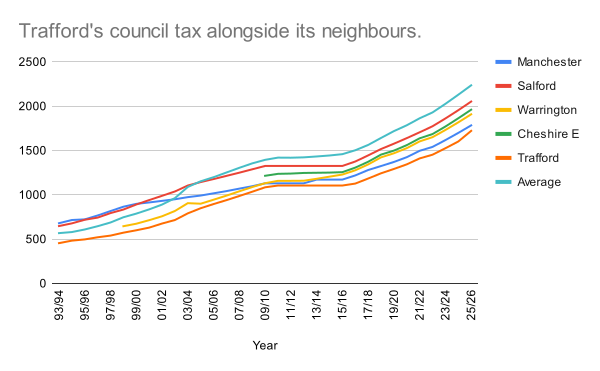
The graph below shows how Trafford has always lagged its neighbours in terms of council tax. Note the uppermost plot is the England average. All these local rates are lower than the average.
AI generated image by the author using Gemini
Leave a Reply