Following one of the worst council meetings I can remember and there’s been some bad ones, it was nice to confirm I’ve got tickets for Neil Young / Elvis Costello in the summer.
Music is important to me. I’m still searching for a radio feed that gives me a perfect mix and no talk. BBC 6 music is closest in my tastes, but they hardly ever shut up.
……and the same goes for council! – 😊
I sometimes listen to Radio Paradise from the states. And I’ve been playing Fip Monde from France for (+15) years since it was featured on the Today programme – it’s world music and it’s rare to hear anything I’ve heard before. Still more often than not I just ask Alexa to play a particular song and let the algorithm take over.
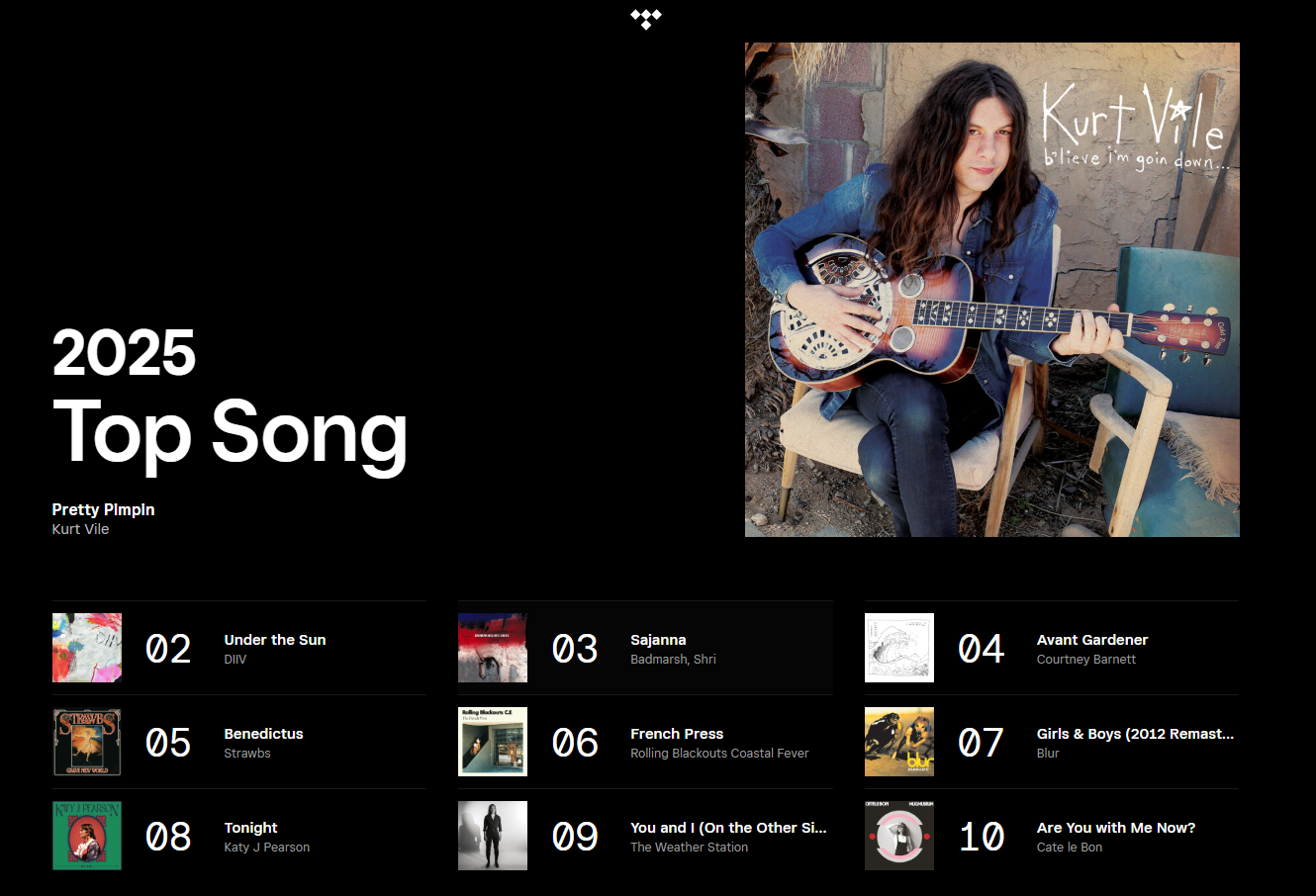
Regardless of this December is the time for the music streamers to tell listeners what they’ve been listening to the most and I can never resist checking it.
This is mine. I’d love hear yours. I don’t know how accessible they are if you’re not signed up. I know I can still play somethings on Spotify despite not being with them for a long time.
Davyhulme Sewage Works is a fascinating place. I was one of three Trafford councillors to take up a guided tour provided by United Utilities. It’s a place I’ve always been aware of; famously because of its smells, but also because of the space it takes up alongside the ship canal. As a youngster I used to cycle over to Barton Airport to watch the planes and we’d take short-cuts over water courses and outflows to get to the locks. It’s a huge site.
The pong associated with the sewage works has noticeably receded. I’m not going to pretend it’s a become a canal-side idyll, but there’s no doubt there’s been significant improvement. It was also apparent that the technology is also improving even if the basic infrastructure still has components of the original 1894 works.
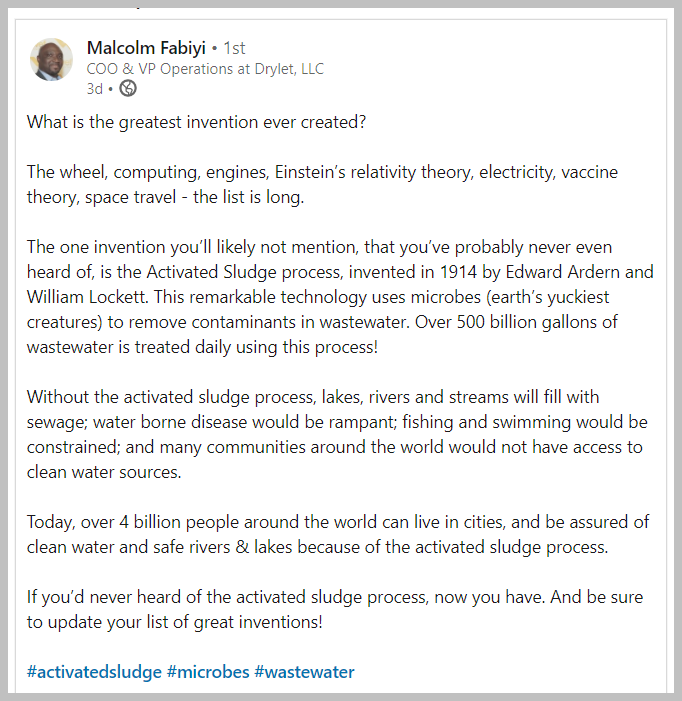
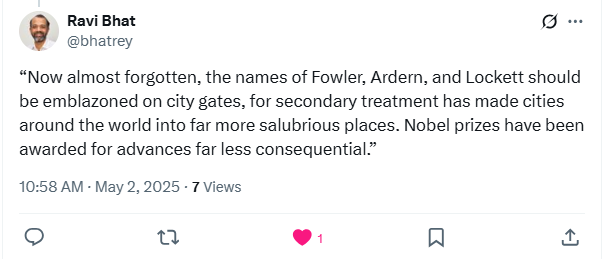
Davyhulme is long associated with technological innovation and we really don’t give enough attention to the development here in 1914. Searching the web just throws up the odd burst of enthusiastic exaltation popping up anywhere in the world.
Examples from the web
En 1914, les chercheurs anglais Ardern et Lockett découvrent que la dépollution est beaucoup plus rapide lorsque l’eau usée à traiter est mise en contact avec une biomasse épuratrice [4] déjà formée. Ils déposent ainsi le premier brevet sur le procédé d’épuration qui sera dénommé procédé à boues activées.
A Call for Recognition of Ardern and Lockett in Trafford
How did we come to miss celebrating the centenary in 2014? Ardern and Lockett are celebrated by sewage engineers all over the world. Why no statues, no streets named after them? Are we ashamed of poo?
Where are we now?
The process Ardern and Lockett developed is still in use all over the world. The demand on it has never been greater. Of course it’s been improved and there are new investments coming through.
Davyhulme wastewater treatment works is set to undergo an initial investment of around £350m over the next five years to ensure it meets the needs of a growing population and higher environmental standards that will improve water quality in the Manchester Ship Canal.
Clearly, I welcome this investment. However, it is long overdue.
I don’t believe that water should be privatised. It is to the everlasting shame of the Conservative Party that we allowed our infrastructure to deteriorate to such an extent that processes I’m so proud of at Davyhulme and each and every other treatment works have to by-passed when the capacity can’t cope with sewage discharged directly into the rivers and canals.
We are where we are and whilst I abhor the use of rivers, I’ve got to recognise that the infrastructure that first receives the rain water as it comes down on us in ever increasing downpours is under the council control.
We’ve got to keep our drains and sewers clear. We’ve got to encourage each other to respect the drains and toilet flushes. Wipes should never go down the loo. Even if the manufacturers claim their product to be bio-degradable, the wipes never degrade quick enough not to contribute to the giant fat-balls that block the sewars. And even when the wipes make it through the system, they’ve still got to be removed and taken to landfill.
Mea Culpa
It’s not just wet wipes. I might not be guilty of disposing of those in the system, but I saw the amount of grit and small pebbles that make it through to Davyhulme, which is but a small proportion of the amount building up in our drains.
It was impossible to avoid thinking of ‘Stretford Beach’ and the amount of pebbles building up from there in the drains. Should we ever be using pebble and grit in ways that it’s impossible to avoid large amounts entering the drains?
Let’s keep the drains flowing.
Finally,
Strongly recommend a visit to Davyhulme Sewage Works. It’s absolutely fascinating.
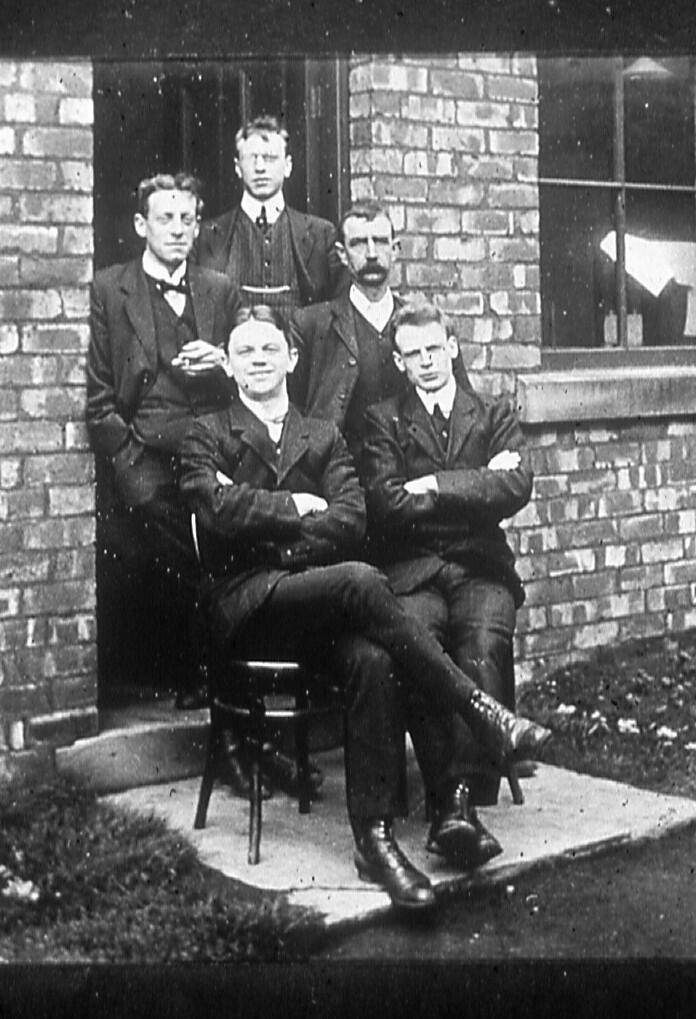
Edward Ardern smoking and William Lockett sat front right (photographer unknown)
Fierce Winds Conspire, The Dark clouds Do Gather……
There are times when, a good report with confirmation that you are doing everything that you should do, is the last thing you want to hear. The storm is coming still.
We’ve actually had two reports on the council’s sustainability, one following the other. Neither of the two reports provides a route to delivering council services at a level the public aspires to.
The second of these, our Corporate Peer Challenge, from the Local Government Association is stark reading, but it does little beyond telling us that we’re right to be concerned.
The earlier report from the Chartered Institute of Public Finance and Accountancy (CIPFA) is the one that’s providing the action plan that came to Accounts and Audit Committee this week.
There’s a danger that the issues are seen as temporary problems of liquidity that the government could solve. There’s a sense that we’re a special case and it’s nothing the public should worry about; we just need Government to listen. I worry that we’re internalising problems that we won’t solve without the public owning both the problems and the solutions.
The public has an expectation that our parks and streets should be maintained to a much better standard than the council even dreams about. They do understand that not enough is being spent on them. They therefore have an expectation that if council tax rises, they will see an improvement. The very fact that we’re unable to meet that expectation is proof that the system is broken.
I think the latest pronouncements from Government on future local government spending suggests that any hope of special treatment for Trafford has now receded. We’re going to have to deal with this.
How do we balance the cost of funding statutory provision in child and adult care with delivering our everyday environmental services? Can we corral those everyday services so that they are directly commissioned by communities and not subjected to competing pressures in social care? How does community wealth building thrive in the current environment?
Ideally, we can work with the combined authority and Mayor Andy Burnham. However, the risk is that the Government’s targeting of funding puts us on a different trajectory to most of our Greater Manchester colleague councils. That risk only emphasises the fact that communities are the only allies still irrevocably facing the coming storm with us.
We must not fall into myopic thinking that balancing the books will be the only test that the public places on us. More than anything they judge us on the state of their neighbourhood. If we can’t insulate spending on neighbourhoods within the council’s spend, I think we ought to be considering alternative models. It may be time for parish councils and/or area boards to come of age.
Photo by Eg Civic Ferio from Pexels: https://www.pexels.com/photo/sea-under-a-storm-cloud-18608634/
A notable scrutiny meeting took place on the 12th March looking at some of the issues that most exercise residents:
How highway interventions such as crossings, yellow lines etc. are prioritised
Pothole repairs and pavement maintenance
Leaf and Gully Clearance
Preventing Accidents
It was the Scrutiny Committee’s attempt at clarity and transparency in the prioritisation of interventions on a limited budget. I think the scrutiny committee made some progress.
There was considerable focus from the committee on why certain projects get to the top of the list and others are held back. The example pursued by the committee was ‘double yellow lines’, something that requires a traffic regulation order (TRO). The presentation included a couple of matrices (shown above), but the officers hadn’t submitted all of them and they promised to follow up by submitting the TRO matrix.
Even without the relevant matrix I think we can get a picture of how proposals are scored. But then it got slightly more complicated.
Sometimes opportunities arose to attach the job to another funding stream (examples included Active Travel and the Sale West and Altrincham Network Infrastructure project (Swani)). This could work both ways, bringing forward some projects but holding back others where a cross benefit project might be ‘anticipated’.
Finance – I’m hoping they score cost v benefit in all cases, but the nature of yearly budgeting means it is sometimes only possible to do smaller works
There followed a degree of interogation on whether other interventions could push a project up to the top of the list, a senior councillor’s intervention or a popular petition heard in council.
Overall on Traffic Matrices
Essentially, we’re arguing over crumbs. The allocated budgets are so small that it’s hard to see some worthwhile schemes ever happening. We ought to have transparency regardless of the budget. These decisions are far less complex than officers and lead councillors protest. I don’t have a problem that political imperative might play a part in decisions as long as we can see that it has been applied.
The public are seeing comparatively vast amounts put into active travel. Whilst that is an entirely separate budget, I think the public want to see objectivity and prudence applied to those schemes too.
I would like to see all the various matrices and projects published on the council’s website. We’re going to have seek solutions to this growing backlog of work and the more we can be upfront about it, the better.
Two thirds of our footpaths are functionally impaired
Footways v Highways
“Footways are obviously a big priority for us, but we have to first and foremost , go with the safety issue and where we can have the most impact on safety. So, the fast majority goes on the ABC network and not on the U class network.” – Chris Morris
Generally, this is fair. If it was just four-wheeled motor vehicles, I could argue that damaged urban roads reduce speed and improve safety, but the effect of a pothole on two-wheeled vehicles can have fatal repercussions.
Nevertheless, our footways are in an unacceptable condition. This is a critical element of our activity supporting infrastructure that’s unusable for a lot of people and it’s getting worse.
Pothole repairs
My colleague, Cllr Simon Thomas, raised the quality of pothole repairs. He said he was astounded that we were not sealing the potholes and argued that we should also cutting the hole square for a better fix.
I’m not sure I understand the response from officers in terms of the specific question, but I do get that the underlying condition of the road is the primary concern of the road engineers since the pothole is only the visible manifestation of a larger condition deterioration. That said, if pothole repairs are disintegrating within a short space of time, we need to know.
Vision Zero / Road Safety
Greater Manchester has talked a good talk on reducing serious injury on our roads, but I really haven’t seen proactive responses. I thought the most interesting comment was that Trafford officers described the Vision Zero team as being ‘resourced’ (as Trafford sees when they regularly meet). My take is that we need to see output from ‘Vision Zero.
I’ve only skimmed the surface of the information submitted to Scrutiny Committee, but I’ve tried to pick out the key elements that are of concern to residents. It’s well worth watching the whole exchange. By all means add your comments below and I’ll try and respond.
Reform is needed. The number of people on benefits due to ill health has increased exponentially. Long waiting times within the NHS are contributing to this, but they aren’t the whole story.
The government has clearly determined that financial incentives to be ‘on the sick’ rather than unemployed contribute to this. If this was all they were looking at, I think there would be room for useful reform, but only at the edges.
The government has instead chosen a stark change to Personal Independence Payments. Applicants will need to achieve a single 4-point score in the daily living assessments.
The Resolution Foundation think tank said the tightening of PIP eligibility would mean between 800,000 and 1.2 million people losing support of between £4,200 and £6,300 per year by the end of the decade. That’s a big change. My colleague, Cllr James Wright has pointed out that Pip often enables work rather than compensating the lack of it.
James is a passionate Wolves fan*.
I am worried that Rachel Reeves is relying on the wrong advisers. There are welfare changes that would make sense, bringing prescription charges in line with state pension age, for example. She seems to have bought into the line that we can solve the economy by removing welfare rather than reforming work, which is what is really needed.
Rachel would benefit from listening to Sean Farrington of the BBC. His radio programme ‘Payslip Britain’ highlights the extent to which work and lack of control within it is damaging our wellbeing. Nine million people not in work and not looking for work is a mindblowing figure. I remember the UK reaching a million unemployed in the seventies. It was considered a seismic change. If work is negatively affecting our well-being, I’m not sure that being cruel to disabled people is going to motivate people back into work.
For the avoidance of doubt, were I to be given a vote, I would vote against the changes to PIP.
*I only mention the Wolves allegiances, so that both could be reassured that they weren’t alone in this world or Manchester. 😊But this radio programme is a must listen!
Trafford’s annual budget meeting is traditionally the biggest set-piece event of the council year. It typically stages a buoyant ruling party, setting out delivery of its priorities, against the harping of a grieving opposition party. This year, however, felt decidedly different in mood.
This was a difficult budget. Trafford has had to be granted a borrowing facility in order for its finance officer to sign the budget off as ‘robust’. We’ve also been allowed to increase council tax a little more than our neighbouring councils. Whilst that’s a tricky position, it does feel to me as though Trafford is being allowed to begin navigating a course back to sustainability after having been cut adrift by the previous government, whereby an already frugal council was denied the ability to steer clear of rocks.
So, I think I’m probably somewhat more optimistic than the majority of councillors speaking in the budget debate on Monday evening.
A good thing that has emerged from Trafford’s current financial plight is that there is more openness about how Trafford spends council tax payers’ money. We are still short of total clarity, but there’s been a definite positive shift. That transparency will be a prerequisite for pulling out of this. We have to take the public with us.
I’d really like us to complain less about how Trafford is somehow singled out by central government for unfair settlements. If we say it’s unfair then we’ve got to design a formula that gives Trafford more compared to a more deprived borough like Knowsley, a borough regularly cited in council documents. The simple fact is that Governments of both the left and right expect comparatively affluent boroughs to use local residents for income. Whilst the design of council tax has internal flaws, even with reform, Trafford will still be left needing to levy its citizens. So, whatever the form of that local taxation, keeping it low will carry the same risks the next time a government sets limits on how much it can be increased. I don’t believe Local Government Finance reform is going to be our salvation. This issue will return again next year.
Given the preponderance of adult social service demands in depleting the council’s finances, it was surprising only Liberal Democrat councillor Simon Lepori raised the delay in its reform as an issue. He made a good point. It was a shame his party chose, as it usually does, to pick a completely irrelevant diversionary proposal as its budget amendment. The opposition parties struggled. There was no alternative budget proposal and that Lib Dem amendment was effectively about independence for Timperley.
Although the budget passed, the work to keep costs down will have to be a daily obsession for the council. Tom Ross gave the speech of the night and it’s clear he gets this. We need to maintain the transparency and that includes the stress that we’re still next to bottom of the council tax charts.
Manage Consent
To provide the best experiences, we use technologies like cookies to store and/or access device information. Consenting to these technologies will allow us to process data such as browsing behavior or unique IDs on this site. Not consenting or withdrawing consent, may adversely affect certain features and functions.
Functional
Always active
The technical storage or access is strictly necessary for the legitimate purpose of enabling the use of a specific service explicitly requested by the subscriber or user, or for the sole purpose of carrying out the transmission of a communication over an electronic communications network.
Preferences
The technical storage or access is necessary for the legitimate purpose of storing preferences that are not requested by the subscriber or user.
Statistics
The technical storage or access that is used exclusively for statistical purposes.The technical storage or access that is used exclusively for anonymous statistical purposes. Without a subpoena, voluntary compliance on the part of your Internet Service Provider, or additional records from a third party, information stored or retrieved for this purpose alone cannot usually be used to identify you.
Marketing
The technical storage or access is required to create user profiles to send advertising, or to track the user on a website or across several websites for similar marketing purposes.