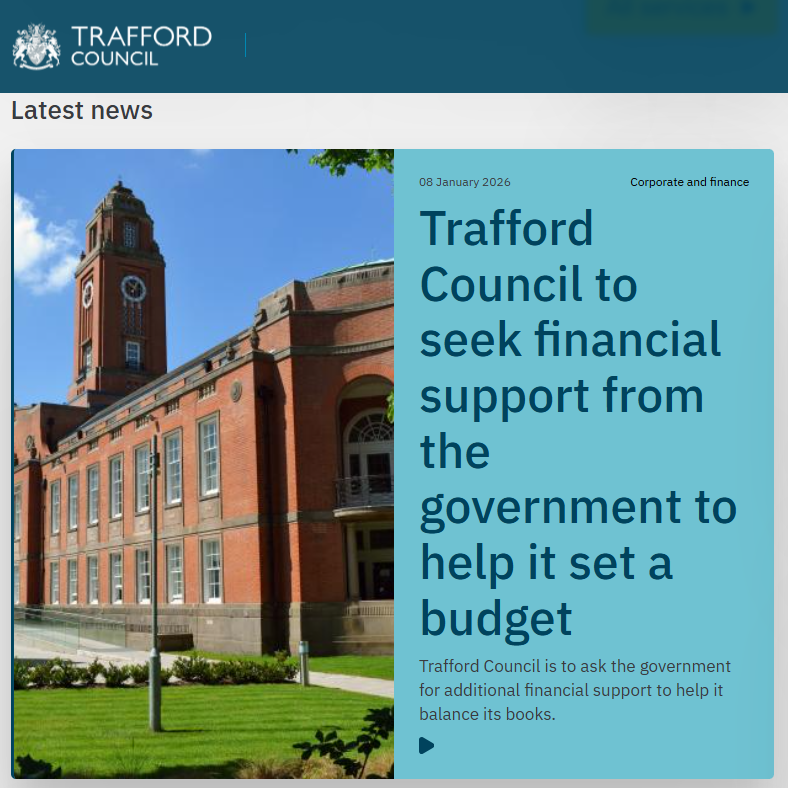
The budget is published and the link is below. The council itself is recognising that the budget outcome is not the one it wanted, that there is a gap between the cost of the services it needs to deliver and the income that the council can raise (and keep).
I can’t add to the official line linked above. As I see it, the changeover to a new fairer funding model has left Trafford on the wrong side of a line. We’re flagging this up to the Government and seeking a financial accommodation from them.
Trafford remains a council that collects more money than it is allowed to spend itself. That surplus is only going to get bigger with projects like Therme and the Manchester United district. The idea of bankruptcy is just ludicrous.
It makes sense to look at Trafford’s income on its own. Trafford’s income is largely a case of what you see is what you get, with just a few areas of choice, notably the Green Bin charge which goes into reserves.
The Current Budget (25/26)
The cost of Trafford’s current services being delivered for this year is £233m. This has come from:
Business Rates £81m
Council Tax £139m
Reserves £3m
Capitalisation Direction £10m
It’s worth emphasising that there is absolutely no mention of Government funding. This conceals the enormous impact Government makes on the distribution of collected business rates.
Trafford collects a lot more than £81m from business rates on its businesses. In 24/25 the amount was £152m. So where’s that >£70m gone?
This leaflet was issued prior to a public health settlement that slightly boosted the budget. The figures at the top of this section are correct.
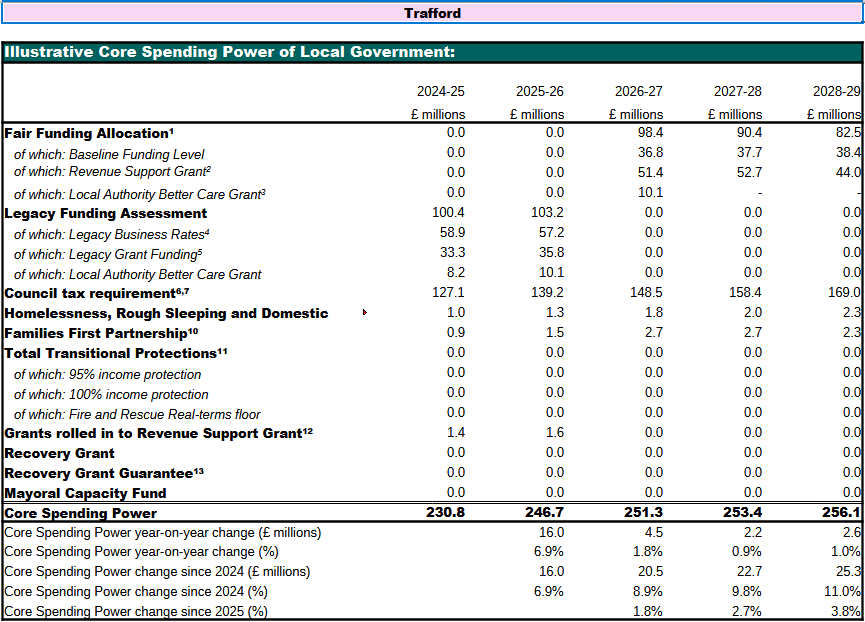
The Local Government Finance Settlement for 26/27
Despite the fact Trafford’s funding is entirely locally sourced, the Government (of all persuasions) is never going to allow Trafford free rein. In December each year the government issues the finance settlement.
For 26/27 England’s average increase in spending will be 5.7%.
Trafford’s increase will be 1.8%.
This assumes Trafford will increase its council tax by the 4.99% limit.
So, the starting point for Trafford’s budget setting is council tax going up by 4.99%, yet Trafford’s core spending will nudge up just 1.8%.
Only 1.8%! Where’s my council tax going? Where’s the increase going?
It’s a fair question to ask.
I suspect that both capitalisation direction (borrowing) and use of reserves were contributing to the current year’s spending power. The trouble is that they were one-offs and we haven’t got them next year. And it has to be stated that they haven’t got us out of a hole and the reserves are finite.
What about other councils?
We’re not alone nationally, but within Greater Manchester it almost feels as though we are. Greater Manchester has always been mix of the relatively prosperous alongside some of the poorest. That missing chunk of business rates is retained within Greater Manchester to support less prosperous areas here. That used to be fair.
My view is that the latest local government settlement is putting strain on the Greater Manchester consensus. Manchester Council is seeing a huge increase from this settlement, yet Trafford is a net contributor.
Nonetheless, our council tax on domestic properties is still low in comparison to our neighbours. Does it need to go higher again?
What next?
The draft budget needs to be published by midnight tonight. There has to be an emphasis on the word ‘draft’. Income is only half the story. We need the draft budget to understand spending pressures or easements.
Technically, the Local Government Finance Settlement is under consultation. I’m confident Trafford will have been making the strongest representation. There’s been some discussion in political journals that the calculation Government is making is favouring London by weighting the cost of housing. Instinctively, that feels like double counting since housing costs have to contribute to deprivation which is the major weighting within the settlement.
However, for Government to make changes to the formula would change everyone’s settlement. They’re not going to change the formula.
I think we do need to look at the Greater Manchester formula.
With regard to last year’s exceptional permission to borrow, I don’t think we ought to accept a regurgitation of that permission to borrow yet more money if that turns out to be government’s solution. That way is one-way and it ends in tears.
I want to understand business rate growth and that’s’ something I’m keen to see in the report. Trafford has benefited from growing its business rate base. That’s being reset by government but looking at the Old Trafford area, there is still potential to grow it still and that’s an aspect to give some optimism.
Finally,
The selfish reason for writing this that the writing is helping me understand the budget. I don’t want to rely on officers. I’ve had to go to core material. Hopefully, I’m able to share some of that knowledge and test it,
We’re waiting for the draft budget to be published which is scheduled as it stands for the 6th January 2026 as part of the reports for the Executive on 14th January 2026.
I’d be surprised if the Government issued anything further in the meantime. Although, you’d anticipate a lot of one to one communication with Councils negatively affected by the settlement proposals. Trafford is certainly looking to discuss.
Despite there being little to report, I do think the data published by the Government each year on council tax changes is worth a glance, particularly as Alison McGovern seemed to put some stall on average council tax.
The table below compares the rates paid in Trafford to the average in England* and to Stockport. The year 25/26 is the first time that Trafford has closed the gap by even the most marginal amount.
*not totally sure I’m comparing like for like on the average table as both county councils and mayors are not universal. As Stockport is a GM council, there’s much more assurance in the comparison.
Trafford still has a low council tax regime. Over the decades this meant Trafford denying itself millions year on year. Some might argue that this is due to Trafford having a tight political competition for control, but if anything, the competition in Stockport has been even more fierce. So, it is what it is, but isn’t allowing sudden changes in income to be cushioned against.
It’s my intention that this post is the first in a series of pieces on setting Trafford’s 26/27 budget. One of the main motives for writing it is to get my own understanding of it up to speed. They say that the best form of learning is getting to a position where I can explain it. You’ll have gathered that I am not yet at that point.
So, a starting gun was fired on Wednesday 17th December 2025 with the Government’s publication of a library of documents and a statement to the House of Commons from Alison McGovern, Minister of State (Housing, Communities and Local Government).
It takes just 90 seconds for the Minister to get to a key theme of this Labour Government’s approach to financing local government.
By breaking the link between funding and deprivation, the Tories punished poorer councils. Year after year, they exacerbated inequality. As a result, too many places in this country feel forgotten and left to fend for themselves…
…It is why, according to our analysis, whereas under the old system deprivation scores could account for only 25% of variation in per capita funding applications, under this settlement it is up to 75%, with other important factors such as coastline, miles of road or visitor numbers making up the rest.
So, we know that poorer councils will do better from this settlement than others and Trafford is not one of the poorest. As a Labour man, I totally support the intent. We will need to see whether Trafford is getting sufficient funding. That’s a process that will take us right through to setting the budget in March.
Resources
I’ll add to these as we proceed with budget setting but there’s already vital material online.
Government Publications (Ministry of Housing, Community and Local Government – MHCLG)
Featured Photo by RDNE Stock project: https://www.pexels.com/photo/marketing-exit-desk-notebook-7414218/
Manage Consent
To provide the best experiences, we use technologies like cookies to store and/or access device information. Consenting to these technologies will allow us to process data such as browsing behavior or unique IDs on this site. Not consenting or withdrawing consent, may adversely affect certain features and functions.
Functional
Always active
The technical storage or access is strictly necessary for the legitimate purpose of enabling the use of a specific service explicitly requested by the subscriber or user, or for the sole purpose of carrying out the transmission of a communication over an electronic communications network.
Preferences
The technical storage or access is necessary for the legitimate purpose of storing preferences that are not requested by the subscriber or user.
Statistics
The technical storage or access that is used exclusively for statistical purposes.The technical storage or access that is used exclusively for anonymous statistical purposes. Without a subpoena, voluntary compliance on the part of your Internet Service Provider, or additional records from a third party, information stored or retrieved for this purpose alone cannot usually be used to identify you.
Marketing
The technical storage or access is required to create user profiles to send advertising, or to track the user on a website or across several websites for similar marketing purposes.