BBC radio did a piece on the sustainability of town centres over the weekend. They used Swindon as an example of a new(ish) town centre that was struggling and explored some of the approaches that might be taken. It was an interesting and balanced exposition.
I’m linking to the programme here but it’s only going to be available until late January.
The local Swindon media did a write-up of the segment and that might well stay up a good deal longer.
town centres are important, they matter to people.
Communities want town centres to give identity to the town they live in.
They need to be accessible – don’t ignore parking
The big anchor stores like Marks and Spencer’s are rare and unlikely captures, Focus on independents and smaller units.
Councils (and other public agencies?) should boost footfall through planning the distribution of their own facilities, libraries, sports centres, health facilities.
Bring employment into the town centre – offices above shops etc.
None of this is new, but it’s notable that it’s really only Sale and particularly, Altrincham that scores highly across the piece. Urmston does well in having a thriving hospitality sector and a large secure catchment.
Stretford is undergoing renewal. I’d have liked Trafford and the public agencies it has influence upon to have looked at Stretford as a place to locate some of their services and operations.
Stretford is unique within Trafford as being accessible from all corners of the borough. It’s the crossroads of Trafford. It’s really the place that the town hall should be.
It’s my intention that this post is the first in a series of pieces on setting Trafford’s 26/27 budget. One of the main motives for writing it is to get my own understanding of it up to speed. They say that the best form of learning is getting to a position where I can explain it. You’ll have gathered that I am not yet at that point.
So, a starting gun was fired on Wednesday 17th December 2025 with the Government’s publication of a library of documents and a statement to the House of Commons from Alison McGovern, Minister of State (Housing, Communities and Local Government).
It takes just 90 seconds for the Minister to get to a key theme of this Labour Government’s approach to financing local government.
By breaking the link between funding and deprivation, the Tories punished poorer councils. Year after year, they exacerbated inequality. As a result, too many places in this country feel forgotten and left to fend for themselves…
…It is why, according to our analysis, whereas under the old system deprivation scores could account for only 25% of variation in per capita funding applications, under this settlement it is up to 75%, with other important factors such as coastline, miles of road or visitor numbers making up the rest.
So, we know that poorer councils will do better from this settlement than others and Trafford is not one of the poorest. As a Labour man, I totally support the intent. We will need to see whether Trafford is getting sufficient funding. That’s a process that will take us right through to setting the budget in March.
Resources
I’ll add to these as we proceed with budget setting but there’s already vital material online.
Government Publications (Ministry of Housing, Community and Local Government – MHCLG)
Reform is needed. The number of people on benefits due to ill health has increased exponentially. Long waiting times within the NHS are contributing to this, but they aren’t the whole story.
The government has clearly determined that financial incentives to be ‘on the sick’ rather than unemployed contribute to this. If this was all they were looking at, I think there would be room for useful reform, but only at the edges.
The government has instead chosen a stark change to Personal Independence Payments. Applicants will need to achieve a single 4-point score in the daily living assessments.
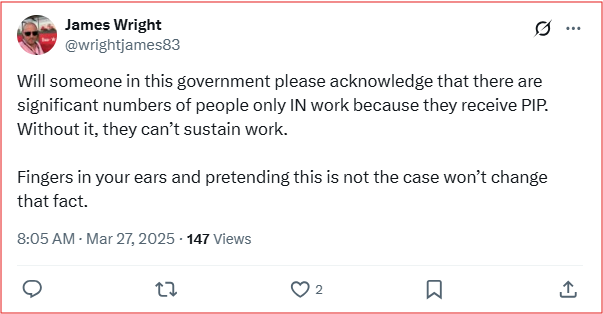
The Resolution Foundation think tank said the tightening of PIP eligibility would mean between 800,000 and 1.2 million people losing support of between £4,200 and £6,300 per year by the end of the decade. That’s a big change. My colleague, Cllr James Wright has pointed out that Pip often enables work rather than compensating the lack of it.
James is a passionate Wolves fan*.
I am worried that Rachel Reeves is relying on the wrong advisers. There are welfare changes that would make sense, bringing prescription charges in line with state pension age, for example. She seems to have bought into the line that we can solve the economy by removing welfare rather than reforming work, which is what is really needed.
Rachel would benefit from listening to Sean Farrington of the BBC. His radio programme ‘Payslip Britain’ highlights the extent to which work and lack of control within it is damaging our wellbeing. Nine million people not in work and not looking for work is a mindblowing figure. I remember the UK reaching a million unemployed in the seventies. It was considered a seismic change. If work is negatively affecting our well-being, I’m not sure that being cruel to disabled people is going to motivate people back into work.
For the avoidance of doubt, were I to be given a vote, I would vote against the changes to PIP.
*I only mention the Wolves allegiances, so that both could be reassured that they weren’t alone in this world or Manchester. 😊But this radio programme is a must listen!
Annual income twenty pounds, annual expenditure nineteen, nineteen and six, result happiness.
Annual income twenty pounds, annual expenditure twenty pounds and six, result misery.
Mr Micawber’s Principle from David Copperfield by Charles Dickens
Mr Micawber’s rules for personal finance are still cited. They rather disregard mortgages and credit, but they still have some worth. The one area in which the rule still pertains with absolute adherence is in local government finance.
The work on the Trafford Council budget is usually largely decided upon by this time of the year. It’s never been an easy task, but we would normally have made our choices and be ready to prepare for the February Budget Meeting of Council. Our choices this year are awful and they’re getting worse.
It’s not just in Trafford either. Strange words and numerals, ‘section 114’ have started to be heard regularly in news bulletins usually accompanied by the more familiar phrases, “council” and “bankruptcy”.
A Section 114 notice is not bankruptcy as a normal business would see it, but no one wants the commissioners in!
In the context of how private businesses manage their accounts, the circumstances of a council having to issue a Section 114 notice bear no resemblance to that of a business facing bankruptcy. It’s just one year where the council’s expenditure is forecast to exceed its projected income. For the chief officer of a council though it’s just about as bad as it can get!
Trafford needs to get itself into a position where it has sufficient income to cover the statutory functions it is obliged to provide in 2024/2025. It will have to do so either by increasing its income or by reducing that expenditure.
Sources of Council Income
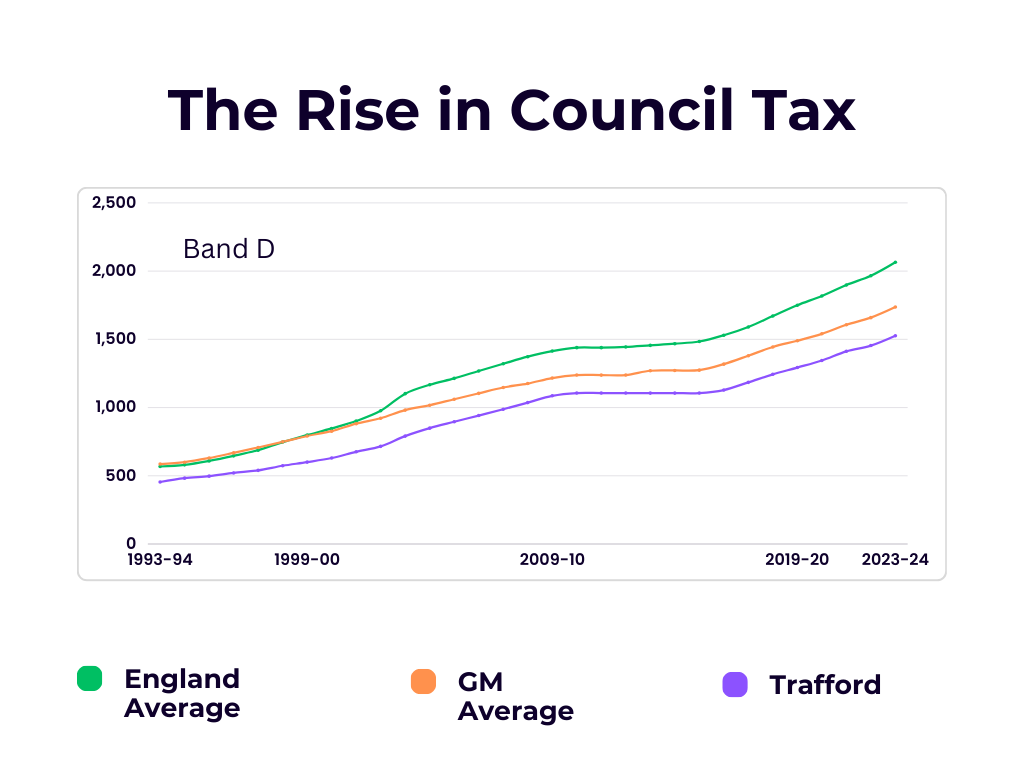
Council Tax is the main source of income. Trafford has traditionally kept council low. Since 2010, the council’s ability to increase its council tax has been limited with a period of effective freeze followed by percentage caps on increases. As a consequence, if anything, Trafford has fallen further behind.
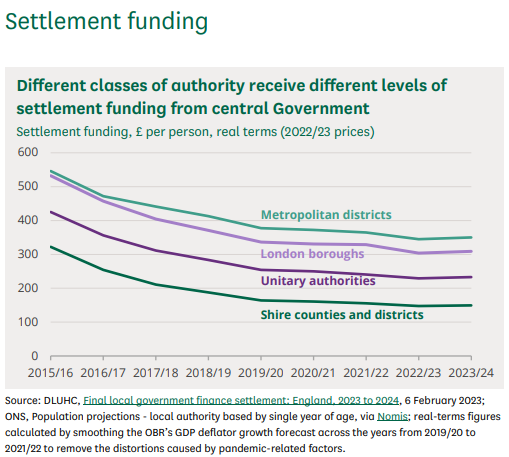
Nevertheless, despite the capping of council tax, the degree to which Trafford relies on Council Tax has increased. In 2008 council tax made up 55% of our income, this year it makes up 58% of our income. The Government has decreed extra responsibilities such as Public Health, but accompanied by lower levels of central funding.
Decline in Central Funding
Fees and Charges
Sales, Fees, Charges and Rents brought in £46m this year and I’m sure there’s an expectation to bring in more next year. The sale of council properties and assets is an exhaustive process. It can be counterproductive and increasing fees and charges beyond what the public will tolerate is a fool’s errand.
Undoubtedly, there’ll be some increases. For instance, I don’t have any explanation as to why we don’t charge for Sunday parking but it wouldn’t bring in huge amounts.
So, Council Tax has to go up again from April!
Our Income
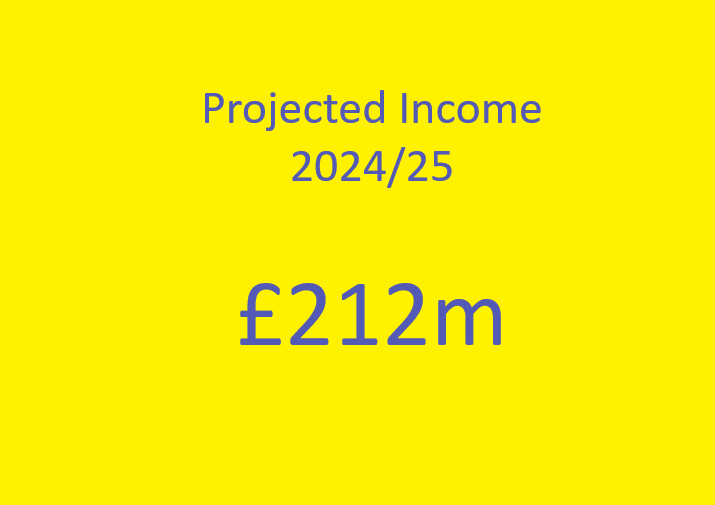
We know that council tax will rise is schedule to rise by 4.99% including 2% dedicated to social care. On top of our council tax income, we’re granted various amounts from Government as well as Business Rates. By December our total funded spending was scheduled to be £212m.
The Government describes this figure as the Core Spending Power of a Council.
Our Spending
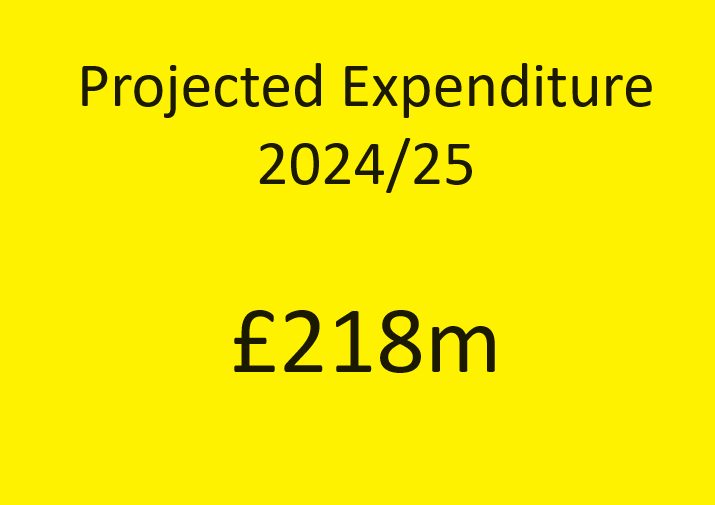
The latest published figures show a projected expenditure of £218m. This figure was included in November’s draft budget. It’s clearly out of date. However, whilst the leadership team were tasked with getting this figure down, we know that actually, the £218m figure has been growing. So it’s getting harder. The government has found another £500m nationally for social care but our share in Trafford won’t be enough on its own to bridge the gap.
If our Council Tax was at the average level in Greater Manchester we would not have this gap, but it would require Trafford to break the Government’s cap on Council Tax increases to get there.
We’re in an especially difficult position because our reserves are so low. We will have to use reserves in the current year.
Whilst the Tory Government has been using Local Government to carry so much of the austerity burden, I’m not expecting any future Labour Government to ride up over the hill and bestow their beneficence on Trafford. We are not in a good position.
I suspect we’ll have to make some painful choices, but we’ll get to a balanced budget. We need to get to a position that is sustainable for a few years and that’s going to be incredibly difficult.
Mr Micawber was wont to say “Something will Turn Up!”.
I totally endorse the message that Keir Starmer gave to the CBI today. There can be no ambiguity, Labour is ready to be a partner to business, working alongside, intervening positively, to get behind the idea, both basic and radical, that our country can grow in a way that serves working people, that higher productivity can come from unlocking their potential, that we can work together to put their interests first.
Manage Consent
To provide the best experiences, we use technologies like cookies to store and/or access device information. Consenting to these technologies will allow us to process data such as browsing behavior or unique IDs on this site. Not consenting or withdrawing consent, may adversely affect certain features and functions.
Functional
Always active
The technical storage or access is strictly necessary for the legitimate purpose of enabling the use of a specific service explicitly requested by the subscriber or user, or for the sole purpose of carrying out the transmission of a communication over an electronic communications network.
Preferences
The technical storage or access is necessary for the legitimate purpose of storing preferences that are not requested by the subscriber or user.
Statistics
The technical storage or access that is used exclusively for statistical purposes.The technical storage or access that is used exclusively for anonymous statistical purposes. Without a subpoena, voluntary compliance on the part of your Internet Service Provider, or additional records from a third party, information stored or retrieved for this purpose alone cannot usually be used to identify you.
Marketing
The technical storage or access is required to create user profiles to send advertising, or to track the user on a website or across several websites for similar marketing purposes.