Category: Blog

  • Sciencing Health

    Sciencing Health

    Delivering world-class research and innovation that improves people’s lives is a core objective of our hospital trust.

    We know that research-active hospitals deliver better care with lower mortality rates and provide a better experience for patients.

    Major clinical breakthroughs – from developing the world’s first bedside genetic test to prevent permanent deafness in newborns, to delivering world-first treatments for Hunter Syndrome – have taken place within our hospital trust.

    As a Governor appointed by the council sit on our Manchester University NHS Foundation Trust, I have the privilege of attending governor development days to familiarise various aspects of work in the hospital trust. This week’s development day was a doozy.

    The morning talk was a series of presentations, the afternoon we had the chance to see the research going on at Wythenshawe.

    Some projects are cutting edge technology and others are really about reaching deep into communities to raise awareness and encourage people to come forward.

    We heard about developments in identifying harmful micro-organisms in lungs. In Intensive Care there is a need to quickly identify which anti-microbial drugs will work and which anti-microbial drugs will not work (because the bugs are resistant to the anti-microbial). One way of identifying the best anti-microbial drug is by looking at the DNA of the bug using DNA spectrometry. This can give much quicker results than traditional methods. The speeds in obtaining these results is improving as is the portability of the equipment. They’re using handheld devices when it used to require a machine the size of a fridge.

    Higher prevalence of a chronic kidney disease within Afro-Caribbean communities is known to be associated with a gene that a minority of people carry, but there remains reticence in coming forward. We heard from outreach nurses that were raising awareness as well as trying to build a cohort of people to track.

    It’s a feature of these types of work that they need volunteer participants. Sometimes participation brings its own rewards, e.g. access to cutting edge drugs or treatments for rare conditions. However, often participation is purely a selfless act.

    It was very much a consistent complaint that Wythenshawe’s chronic car parking shortages do have a particular impact. The example given was that volunteer participants do not want to spend 30 mins looking for somewhere to park their car.

    There’s obviously ambitious development plans for Wythenshawe Hospital, but they’re not going to come to fruition quickly. We’re going to have to return to this issue. I think my inclination is to reserve more parking for the research function. I don’t think we’re talking a huge amount of car parking, but obviously it would have an impact on others.

    Photo by Pavel Danilyuk: https://www.pexels.com/photo/medical-practitioners-doing-a-research-8442280/

  • Setting Trafford’s Budget Pt 8 The Budget is published.

    Setting Trafford’s Budget Pt 8 The Budget is published.

    The Final Budget has been published, ready to be put to council on the 5th March.

    Trafford Council Budget 2026-27.

    In terms of spending choices, as one would expect there’s not a huge difference from the draft budget released in January. The proposed net budget is £274m compared to the £277m originally projected, which is good. It’s about the only good thing on show.

    We knew that the Government had determined that we needed to be able to increase Council Tax by an additional 2.5% compared to the standard rise. That 7.5% is therefore built into this final budget.

    We’ve been granted the facility to borrow £12.64m for the coming year. This is on top of borrowing £9.6m or thereabouts for the year that’s coming to an end.

    Borrowing is not routine, it’s a seismic change.

    The act of borrowing to support day to day spending has always been outlawed and rightly so! I don’t like it at all. Fundamentally, it’s borrowing from future budgets. It’s particularly worrying when future finances do not look any rosier.

    Given this is a three year settlement, you would hope we could see light at the end of the tunnel, but there’s no sign yet of a balanced budget, albeit there is a narrowed gap in 2028.

    I learn from the local democracy reporting service that Sefton is looking to a fire sale of assets to balance its budget. This seems to require Government permission.

    Liverpool Echo Sefton selling off assets to balance budget

    Trafford hasn’t committed using receipts from its land sales. However, the land sales plan routinely contains the paragraph:

    Receipts generated from the disposal of sites as detailed in Category 1 and returns from development of sites detailed in Category 2 are currently earmarked to directly support the Capital Programme, although these could also be used to support the wider strategic management of Council borrowing.

    They’ve not used receipts before, as far as I am aware, to support the management of borrowing, but we’ve never been in this position.

    The more I think of Trafford, Warrington, Cheshire East and Sefton, the angrier I get on their behalf. I can’t believe how passively we’re all accepting this absolutely dreadful settlement from Government.

    Yes, there’s an argument that our council tax level in Trafford is somewhat adrift from what it really ought to be to deliver the standard of service people want, but the comparison with Manchester’s settlement is just too extreme. The difference that’s going to become apparent between Old Trafford and Whalley Range is so unjustifiable it needs to be screamed at Government. I’m appalled.

    Budget Documents

    The 26/27 Final Budget Proposals (109) pages
    Key Parts –
    Report of the Director of Finance and Systems on the
    Robustness of the Proposed Budget Estimates and the
    Adequacy of Financial Reserves (Page 9)
    Financial Background (Page 33)
    The Budget – Page 59
    Savings Proposals – Page 86

    Capital Spending

    Treasury Management (Debt and Reserves)

    Fees, Charges and Allowances (everything from parking to cremation charges)

    Budget Scrutiny Response These are the executive’s answers to the recommendations of the scrutiny committee.
    (The Scrutiny don’t seem to have been given access to questions over financing the budget gap. It’s certainly not raised.)
    Given that effective scrutiny was particular emphasis of the peer review of Trafford, I don’t know that this serves Trafford.

  • Getting tetchy!

    Getting tetchy!

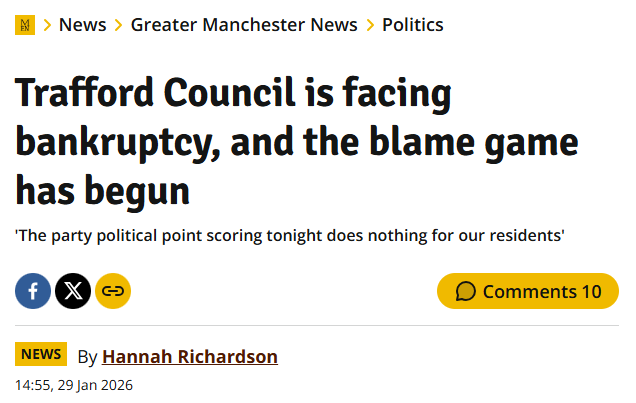
    I read a really good piece in the Manchester Evening News by Hannah Richardson. It captured perfectly the mood of Trafford Council.

    The Conservatives blamed Labour, Labour blamed the Conservatives, and the Greens pointed the finger at every other party present.

    Hannah Richardson MEN

    We’re still waiting for the Government’s decision. It normally lands by the end of January, so everyone’s feeling a bit on edge.

    Somerset Council has already had to postpone their budget meetings in the absence of the final settlement.

    One can imagine that the team led by Nico Heslop (Director of Finance) at MHCLG has had its work cut out in listening to the protestations of councils like Trafford over the proposed settlement.

    My guess is that we will learn our fate this week. It will be good to channel all this nervous energy into constructive activity.

    The Conservatives as main opposition party will want to put an alternative budget forward. The other parties might want to propose tweaks. They clearly need to see the Labour budget first.

    If the law dictates that it all has to be done and dusted by March 11, we really need that final settlement agreed.

    Link to Manchester Evening News Article on the Council Meeting of 28 January 2026

  • Setting Trafford’s Budget – it’s over to the Government

    Setting Trafford’s Budget – it’s over to the Government

    There’s been a couple of meetings this week. We’ve had the formal posting of the Draft Budget at the Public Executive. That was followed by the first meeting of scrutiny committee in relation to this year’s budget.

    Normally, the scrutiny committee would have begun looking at this much, much earlier. They’d have looked at options and they’d have looked at the longer term context. Personally, I regret the omission of that earlier work. Scrutiny would have added to the case being made to government. We are where we are and I’ll leave that particular issue at that.

    The Executive meeting was rather long, but the draft budget was formally adopted. This means we’ve set a balanced budget only on the basis of a £20m facility to borrow, that can only be granted by government in the form of Exceptional Financial Support(EFS).

    It’s now down to the government whether to grant EFS in the form we’ve proposed (a loan) or in some other way. There’s an intense dialogue ongoing with Government and lobbying alongside our MPs. That won’t let up, but the government is moving from consultation to finalising the settlement and tabling the regulatory instruments.

    I have no idea what to expect from Government and there is nothing to be gained by speculating at this late stage.

    Let’s hope that there’s a route that puts us on a sustainable financial footing.


    I did receive responses to the questions set out in the 5th piece. My verdict on the budget for children’s services being tight was conceded. We’re at a place where all the budget lines are tight. I think we just wait for the settlement now. All options are possible, worse, same and getting better. Fingers crossed.

    Photo by Suki Lee: https://www.pexels.com/photo/close-up-of-hourglass-14826119/

  • Setting Trafford’s Budget Pt 5 – Spending

    Setting Trafford’s Budget Pt 5 – Spending

    Essentially, spending is the very core of the budget process. We’re describing how much the council intends to spend and setting out to raise sufficient income to pay for it.

    Councils know there are limits to how much income they can generate, both in terms of the rules and in terms of democratic oversight.

    If Council Tax is too high, the voters will vote for a party that pledges to tax a more reasonable amount.

    Voters also expect to see the benefits of the taxes that the council is taking. They want clean streets, the bins emptying, roads maintained. But it’s not just the state of the place, they don’t want to learn that their elderly neighbour has starved because no one was caring for her. Voters get this, although I don’t think we make it easy for people to see where their money is going.

    So anyway, the council sets out its projected spend by service*. We’re only going to need look at two tables:

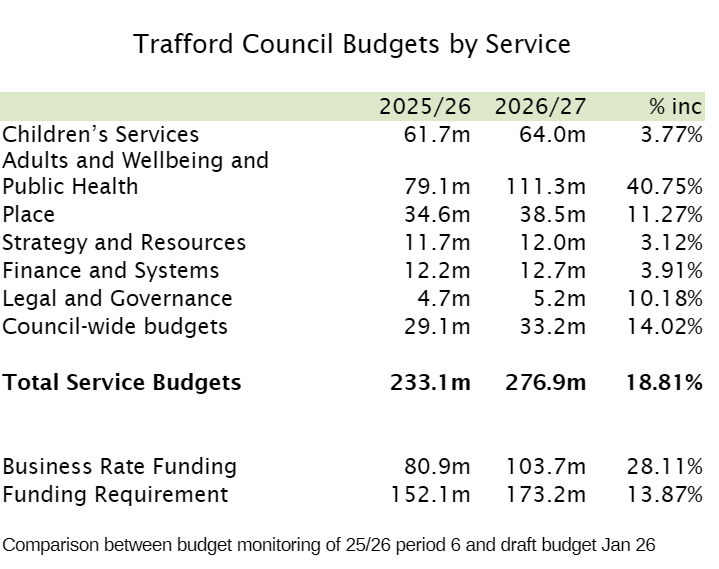
    • A chart comparing spend by service in the current year with that projected for the coming year in the draft budget
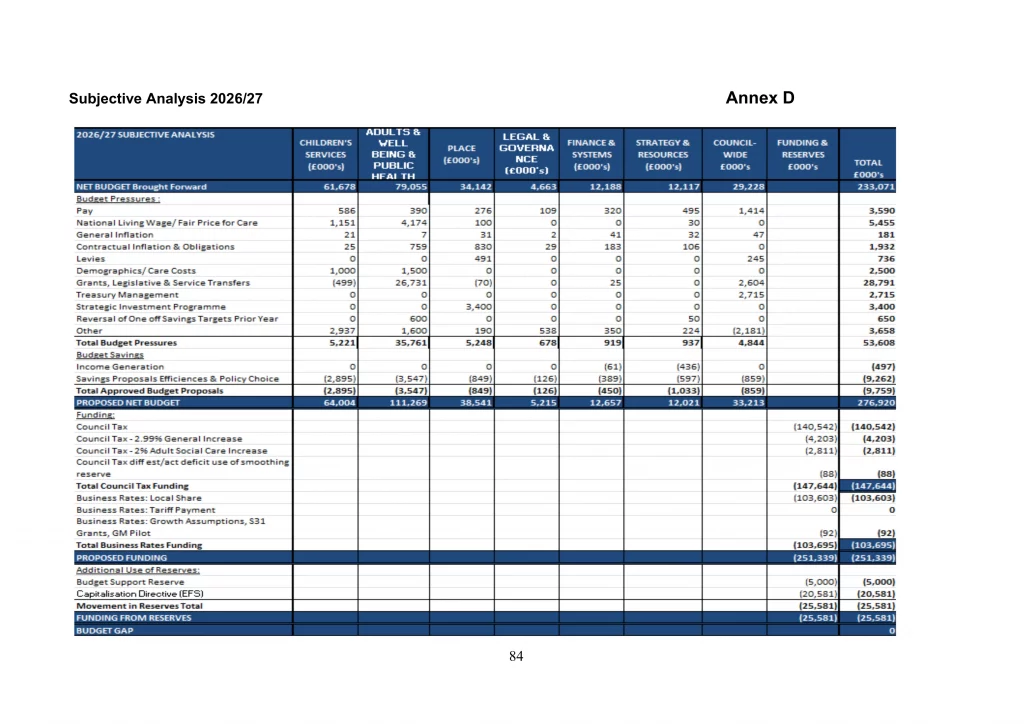
    • Page 84 of the Draft Budget which is titled ‘subjective budget analysis’, but is actually a single table detailing all the changes to spend and why they’re happening.

    *brief descriptions of each service stream are at the bottom of this post.

    The first chart

    With the publication of the draft budget, we can compare the budget for the coming year to what we’re looking like spending in the current year.

    It’s not possible to provide a completely ‘like for like’ comparison. This is where that 2nd chart referred to above is particularly useful. We can see changes to and between funding streams. So, on that chart, there is an unassuming line ‘Grants, Legislative and Service Transfers’, that accounts for £29m of the increased budget costs.

    The explanation is that the government have moved away from many individual grants and rolled them up into being part of the main allocation. This means the cost needs to be brought into the budget

    This has particularly affected Adults and Wellbeing as it’s added £26m to the budget with the other £3m being attributed to ‘Council Wide’ provision. Given the main allocation which is referred to here as ‘business rate’ funding is only increasing by £23m, there’s a shortfall in the funding from government. That’s one aspect that’s made this a particularly difficult budget.

    Nevertheless, in terms of scrutinising the spending plans, it would seem fair to test some of the assumptions.

    Possible Questions for the Executive at Scrutiny

    • That Children’s Services budget looks ambitious. It’s normal that controlling the cost of children’s services that gives the council the most difficulty. What assurance can we have that a 3.77% can be constrained?
    • Legal and Governance seems to be getting quite a large increase of 10.18%. The bulk of this increase is just described as ‘other’. Can you provide more details?
    • Place is receiving a large increase of 11%. Are we expecting to see improvements to delivery? It’s primarily attributed to the Strategic Investment Programme. What will be the visible returns on this investment?
    • The Adult Services budget is seeing major changes with a move away from grants. We’re allocating that loss of grants (£26m) to the main budget. Given we’re not being compensated in business rates to the same level, would we not be justified in reducing the provision to a level commensurate with that now provided? What would be the effect?
      In any event how are we going to monitor this provision in the absence of grant funding for which monitoring would be standard.
    • I think we’ve also got to monitor head counts. We’ve invested quite a lot over the years in IT and efficiency. We don’t usually receive details of head counts, but I think the very fact we’re having to apply for support means we’ve got be transparent.

    Appendix
    Trafford’s service headings

    As a quick addendum, I just wanted to provide this brief description of service headings. Do we need quite so many? I’ll leave that for another day.

    Children’s Services

    includes a vast range of support services designed to help children and young people who need extra support.

    Adults and Wellbeing including Public Health

    a vast array of services many of which are statutory under the care act 2014

    Place

    The Place directorate provides all those services linked to buildings and the ‘place’ we live in. From bins to planning.

    Strategy and Resources

    Typically, things that Trafford operates as entities such as libraries and bereavement services.

    Finance and Systems

    IT and financial management activities

    Legal and Governance

    Registrars, Legal

    Council-wide

    Includes Asset Investment, Council Tax Support, Treasury management

  • Setting Trafford’s Budget Pt 4 (Draft Budget Publication)

    Setting Trafford’s Budget Pt 4 (Draft Budget Publication)

    10:05 pm 6th January 2026

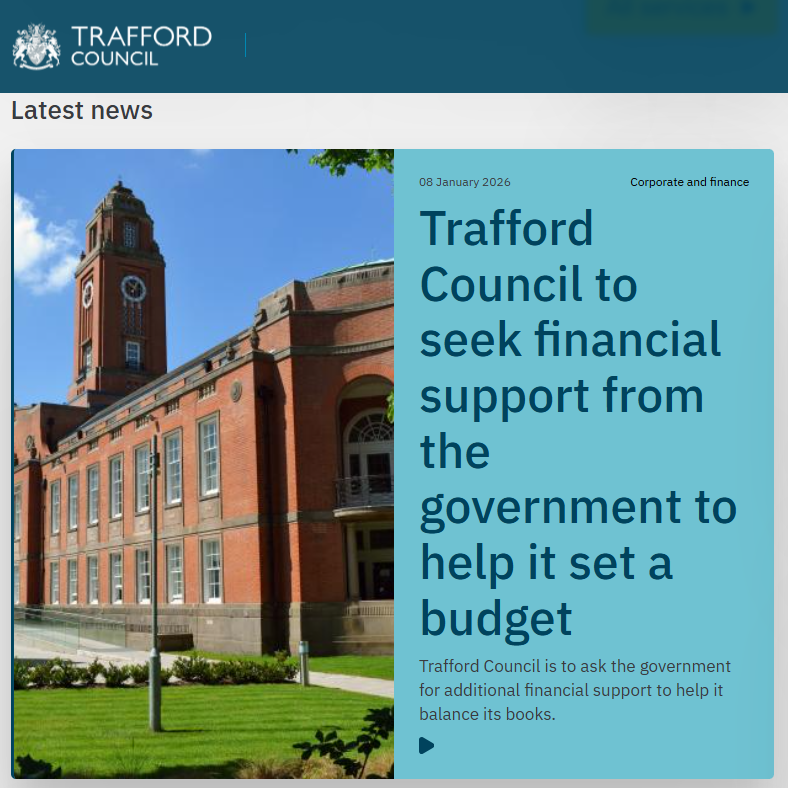
    The budget is published and the link is below. The council itself is recognising that the budget outcome is not the one it wanted, that there is a gap between the cost of the services it needs to deliver and the income that the council can raise (and keep).

    I can’t add to the official line linked above. As I see it, the changeover to a new fairer funding model has left Trafford on the wrong side of a line. We’re flagging this up to the Government and seeking a financial accommodation from them.

    Trafford remains a council that collects more money than it is allowed to spend itself. That surplus is only going to get bigger with projects like Therme and the Manchester United district. The idea of bankruptcy is just ludicrous.

    Featured Photo by RDNE Stock project: https://www.pexels.com/photo/marketing-exit-desk-notebook-7414218/